
Digital Learning Platform, Education, Grammar, High School, Homeschool, homeschool curriculum, Middle School, Novel Studies, Online Learning, Unit Study

Beyond the Flame: How Literary Adventures for Kids Helped My Teen Go Deeper Into Fahrenheit 451

When your teen falls in love with dystopian literature, you follow the trail with them. My son recently dove into The Hunger Games, then The Giver, and most recently Fahrenheit 451. But after finishing Bradbury’s classic, he came to me with big, layered questions about censorship, symbolism, society, and why Bradbury wrote the book the way he did. He wanted to dig deeper, not just gloss over the content. I searched for a novel study that could match his curiosity, but everything I found felt rigid, overly academic, or full of busywork. Then I remembered we still had our Literary Adventures for Kids account. To my relief, they offered a Fahrenheit 451 study, and once I opened it, I knew immediately that it was exactly what we needed.

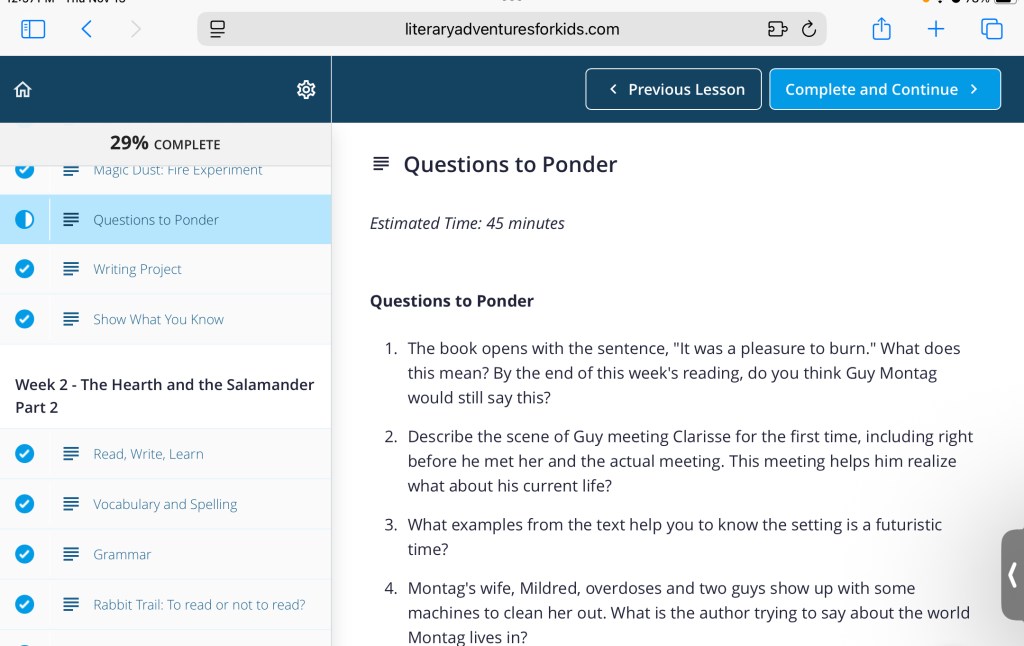
Literary Adventures for Kids (LAK) is an online, self-paced literature platform designed to bring stories alive through exploration, multimedia learning, and intentional Socratic-style questioning. Instead of draining the joy out of reading with endless worksheets, it enhances the experience. The digital layout is clean and easy to navigate, and lessons are structured in a way that encourages deep thinking without overwhelming the student.

What Makes Literary Adventures for Kids Stand Out

LAK avoids the “read-and-regurgitate” approach that turns teens off from literature. Instead, it blends academic depth with interactive, curiosity-driven learning. Students are guided to think critically, question themes, and draw connections between the story and real-world issues.

Some standout features include:

  • Rabbit Trails of Wonder — These guided explorations help students dive deeper into topics related to the novel, such as censorship, propaganda, technology, or Bradbury’s historical context.
  • Socratic-Style Discussion Prompts — Instead of factual recall, LAK offers open-ended questions that push students to analyze, interpret, and evaluate the author’s message.
  • Creative and Multi-Sensory Activities — Journaling, copywork, theme mapping, mini-projects, and multimedia clips enrich the learning experience.
  • Rigor Without Burnout — Lessons feel meaningful and meaty, but never overwhelming or monotonous.
  • A Diverse Catalogue of Books — The platform offers a wide assortment of titles, from classics to contemporary YA, diverse authors, and culturally rich stories.

Inside the Fahrenheit 451 Study

The Fahrenheit 451 study was the perfect blend of analytical, creative, and reflective learning. Each module invited my son to slow down and consider the symbolism that runs throughout the book. The platform included context about book banning, historical events that shaped Bradbury’s writing, and discussions that helped my son articulate his thoughts clearly and confidently.

He especially loved:

  • exploring rabbit trails about censorship and media control
  • watching short, curated videos that expanded his understanding
  • answering Socratic-style prompts that made him think deeply
  • journaling about the ethical dilemmas in the story
  • comparing Bradbury’s warnings to today’s society

This study didn’t talk at him it invited him into a conversation with the text.
A Strong, Diverse Book Catalog

One of my favorite aspects of Literary Adventures for Kids is the variety of books available. Their catalogue includes:

  • classic literature
  • modern young adult novels
  • diverse and multicultural stories
  • high-interest titles teens actually want to read
  • newer releases and timeless favorites

It gives homeschool families the freedom to choose books that align with interests, learning goals, and cultural representation all while maintaining academic richness.

Final Thoughts

Literary Adventures for Kids brought our Fahrenheit 451 experience to life in a way traditional novel studies simply couldn’t. My son thrives on interactive, thoughtful, and well-designed lessons, and LAK delivered all of that with ease. It made him excited to revisit the novel and unpack everything he was curious about. Instead of draining his enthusiasm, LAK amplified it.

If you have a teen who prefers Socratic dialogue, multimedia learning, and meaningful exploration over worksheets, this platform is a gem. It respects how middle and high school students think, question, and understand the world.

If you’re ready to turn novel studies from dry assignments into immersive, curiosity-driven adventures, take a look at Literary Adventures for Kids.

Fahrenheit 451 warns us about what happens when people stop thinking
LAK encourages our students to think deeper, question boldly, and let their love of literature burn bright.

Curriculum, Curriculum Resource, Homeschool, homeschool curriculum, Science

A Non-Religious Science That Delivers: Our Take on Real Science Kids Level 4

We recieved a copy of Real Science Kids Level 4 for our honest review!

We’ve finished our hands-on walkthrough of Real Science Kids Level 4 (newest release) and this is our final, comprehensive review of the series. If you’ve been following our earlier write-ups of Levels 2–3, this review ties everything together, compares how Level 4 builds on those earlier levels, and explains why this level is especially suited to some 4th graders and not to others.

Overview what Level 4 is at a glance

Real Science Kids Level 4 steps up both the depth and pace of science instruction compared with the early levels. It keeps the series’ hallmark hands-on experiments and approachable explanations, but it accelerates the curriculum: lessons move faster, explanations are denser, and activities expect stronger reading comprehension and independent thinking from students. For a motivated 4th grader who already enjoys science, Level 4 can feel exciting and rewarding. For a student who needs slower pacing or heavy remediation, you’ll want to plan extra time or pair it with more guided instruction.

Topics covered

Level 4 blends life, physical, and earth science in more sophisticated ways. Expect units that include (but are not limited to):

  • Life Science: ecosystems, plant and animal adaptations, food webs, basic genetics concepts
  • Physical Science: matter & its properties, simple chemistry experiments, forces and motion basics
  • Earth & Space: rock cycle, weather patterns, solar system fundamentals
  • Scientific Skills: hypothesis development, controlled experiments, measurement, graphing, data interpretation
  • Practical/Enrichment: lab journals, extension projects, STEM challenges and mini-research tasks.

Why it’s a great fit for many 4th graders

  • Accelerated, rigorous pacing: Level 4 assumes students can read instructions carefully, follow multi-step experiments, and synthesize results into conclusions. That makes it ideal for curious, independent learners who are ready to think like junior scientists.
  • Hands-on emphasis: The experiments and projects are engaging and meaningful they’re not just demonstrations, they ask students to predict, measure, record, and reflect.

Limitations / who should be cautious

Not for every 4th grader out of the box: Because the curriculum is accelerated, students with weaker reading comprehension or poor attention to multi-step instructions will struggle without extra support.

Requires parental/teacher involvement for some students: To get full value, some learners will need guided read-alouds, demonstration of techniques, or pre-teaching of vocabulary.

Pacing expectations: If you use Level 4 as a straight replacement for a slower paced Level 3, be ready to adjust schedule or split some lessons.

How Level 4 compares to our earlier Level 2–3 reviews

When we reviewed Levels 2–3, the series felt very gentle: short lessons, lots of picture support, and very guided, parent-led experiments perfect for early elementary learners. Level 4 clearly intends to bridge to middle-school science thinking: it asks students to do science, not merely observe it. If you used Levels 2–3 in your homeschool, Level 4 will feel like a natural but definite step up. Expect to revisit how you scaffold reading and experiment setup: what worked with Level 3 (read-aloud instructions, step-by-step adult demos) may need to become a bit more student-centered with Level 4.

Teaching tips & pacing suggestions

  • Pre-teach vocabulary: Spend a short pre-lesson on key terms — this pays off on experiment day.
  • Model one experiment first: Demonstrate an experiment as a whole-class (or parent-led) demo, then let students replicate with guidance.
  • Use the lab journal: Require students to write predictions, methods, results, and a short conclusion for every experiment — it enforces scientific thinking.
  • Adjust pacing: If a student struggles, split lessons into two sessions: one for concept + vocabulary, one for experiment + reflection.
  • Pair reading support when needed: For readers below grade level, read directions together or provide a simplified checklist.

Final verdict — who should choose Level 4

Choose Real Science Kids Level 4 if your 4th grader:

  • Already shows curiosity about science, asks “why” questions, and enjoys experiments.
  • Has solid reading comprehension and can follow multi-step directions (or you’re willing to provide a small amount of guided support).
  • Wants a curriculum that accelerates concept development and builds real scientific thinking skills.

If your child needs a gentler introduction to experiments and vocabulary, consider re-reading our earlier reviews of Levels 2–3 and using those as the transition years before moving into Level 4.

Closing notes — our series wrap-up

This is our final review of the Real Science Kids series. We’ve walked Levels 2–4 in previous posts and can confirm the series does continue beyond Level 4 (there is a Level 5–7 tier available for older students). Across the series, Real Science Kids grows from guided, playful experiments into a rigorous, inquiry-focused program and Level 4 is where that transformation becomes most noticeable. If your goal is to accelerate a curious 4th grader toward middle-school science habits, Level 4 is an excellent, thoughtfully designed choice just plan for comprehension support if needed. Real Science Kids Level 4 is a part of the 4th grade Timberdoodle Co Curriculum Kit.

Consumer Math, Education, High School Math, Homeschool, Homeschool math

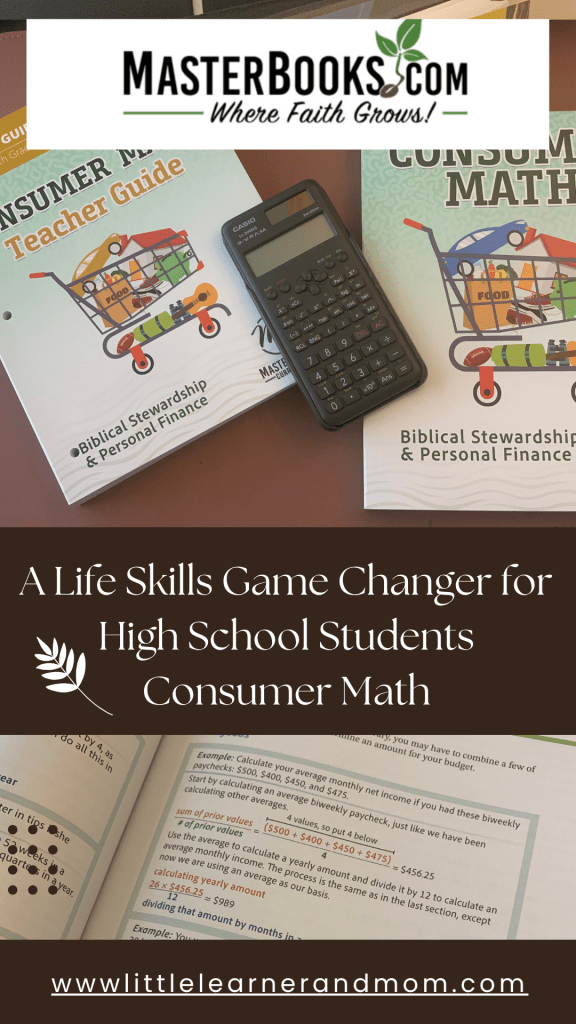
MasterBooks Consumer Math: A Life Skills Game Changer for High School Students

As a long-time homeschool educator, I’ve seen my fair share of math curricula. But I have to say the new MasterBooks Consumer Math for high school students truly impressed me. It reminded me so much of my own Consumer Economics class at my all-girls high school, a class that equipped me with the practical financial knowledge that has followed me throughout adulthood. Those early lessons shaped my financial awareness, and I feel fortunate to have been introduced to them at such a pivotal time. This curriculum brings that same level of intentionality and depth into today’s learning space and honestly, it couldn’t have come at a better time.

Not Just Financial Literacy…It’s Life Literacy

While many programs throw around the term “financial literacy,” Consumer Math by MasterBooks goes far beyond just teaching students how to balance a checkbook or calculate interest. This course is about real-life decision-making, responsibility, and empowerment. Students walk away with the ability to read pay stubs, compare insurance policies, file taxes, calculate gross and net income, create budgets, understand loans, and so much more. This curriculum doesn’t just teach numbers it teaches life.

Faith-Based, But Financially Focused

Yes, this is a faith-based curriculum, and it does include Christian references, but what I appreciated most is that the religious tone never overshadows the real-world financial education being delivered. The scriptures and moral guidance are tastefully woven in, offering values-based encouragement without deterring from the rigorous math and financial content. It’s a wholesome balance, making it ideal for families looking for faith-integrated academics that don’t compromise on academic depth.

Flexible, Organized, and Easy to Implement

One of the things I really appreciate is how user-friendly and well-organized this curriculum is. The book is divided into four quarters, making it manageable for scheduling and lesson planning throughout the school year. This structure gives both students and educators a clear roadmap, reducing overwhelm and making it easy to stay on track.

Additionally, the solution book is available as a digital download, which is perfect for parents who like the convenience of accessing answers and guidance on the go or printing what they need.

And here’s a standout feature: You don’t have to ditch your current math curriculum to use this one. MasterBooks Consumer Math works beautifully as a companion course. Whether your student is working through Algebra, Geometry, or Pre-Calc, this course adds meaningful real-world application without replacing core math instruction.

What Makes It Stand Out?

Several elements make this curriculum a standout:

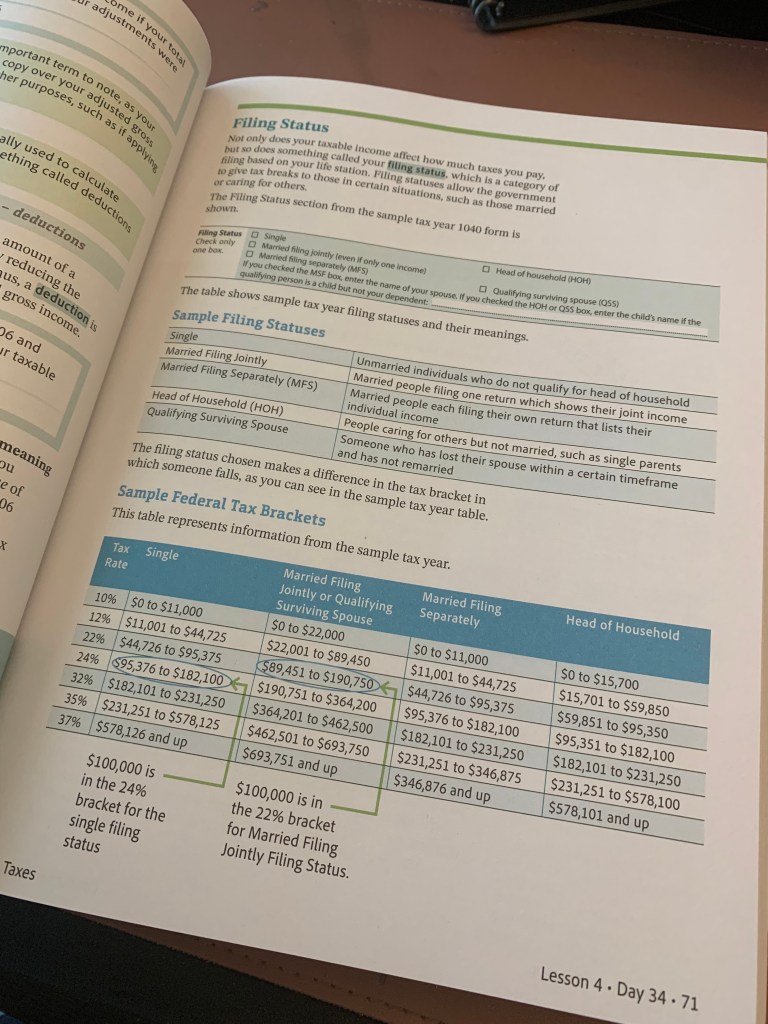
  • Real-World Financial Forms: Students aren’t just learning theory—they’re engaging with real documents like tax forms, bank statements, and pay stubs. It gives them hands-on experience they’ll actually use.
  • Step-by-Step Math Instruction: Each lesson walks students through the math in a way that is clear and unintimidating. It’s also a great way to refresh foundational math skills in a practical context.
  • Colorful and Relatable: The book features vibrant visuals and diverse, real-life scenarios that keep students engaged. Whether it’s shopping, renting, or managing money, the examples feel modern and meaningful.

Who Is This Curriculum Great For?

This would be an excellent fit for:

  • High school students in grades 10–12
  • Homeschool families seeking a faith-based, real-life financial education
  • Students who are visual learners or benefit from hands-on, practical lessons
  • Teens preparing for college, employment, or independent living
  • Families who want to supplement their current math curriculum with relevant life skills
  • Parents looking to give their students a head start in adulting

If you want to check out samples of MasterBooks Consumer Math click picture below:

Final Thoughts

MasterBooks Consumer Math is more than a math curriculum it’s a life prep course. It fills a vital gap by giving students the knowledge and confidence to make informed decisions about their financial futures. The mix of real-world application, faith-based encouragement, and clear math instruction makes this course a must-have in every high school student’s academic journey.

If you’re ready to move beyond textbook problems and start teaching real life, this curriculum is your next best step.

If you want a chance to get your own set of MasterBooks Consumer Math be sure to click the giveaway image for your chance to win giveaway ends August 31st, 2025!

Homeschool, Homeschool Family, Morning Basket, Music Appreciation, Music Theory, Unit Study

Teach Your Child Piano: Read Music Notes in 6 Weeks and Summer Siesta Music Camp Review!

Complimentary product received from Teach Your Child Piano!

If you are followers on our Little Learner and Mom IG you know my son, well our entire family loves music. My son was exposed to music early on in the womb because his dad is a music producer and insisted on playing music to my belly every night. So when my son was born he instantly took to all things music.

My son’s first instrument was the trombone it was like love at first sight from 18 months old until the present. We bought his first trombone when he was 3 and he has been playing every since. When Karen asked me if we would be interested in taking a look at the Teach Your Child Piano course Read Music Notes in Six Weeks and the Music Camp: Summer Siesta course, we were happy to review them.

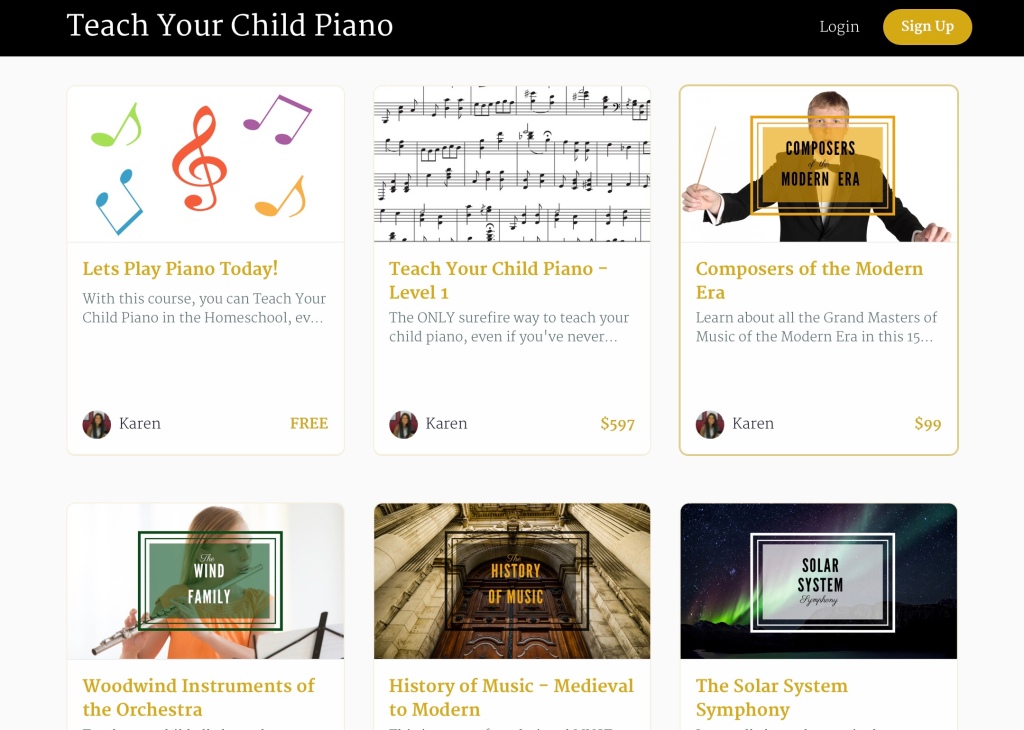
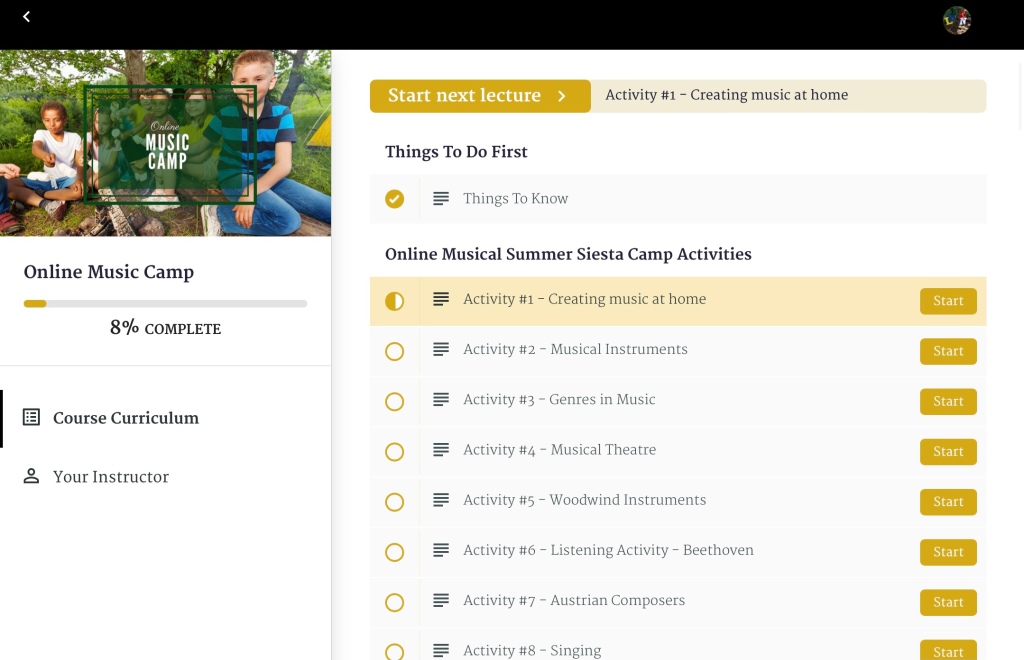
The Teach Your Child Piano courses are on the “Teachable” platform. You will have your own dashboard that includes your course of study. Some of the activities include downloadable pdfs and embedded videos. Not all of the Siesta Summer activities have videos. I think it would be nice if each included one example of the topic. This would be helpful for those students and parents who have no background in music. The platform is easily managed and it tracks your progress as long as you click the continue and complete button.

Read Music Notes in Six Weeks

Read Music Notes in Six Weeks is a great course for beginners who do not have a background in music. My son has a background in music so after looking over the first week, he felt like it was just a little too easy for him. But I am going to base my review on what I think if I had a non-musical child. This is a great course to introduce your students to reading music and music theory. The included a detailed lesson plan, games, worksheets, instructional video, flashcards, and a practice plan.

There are 6 modules that cover:

  • Learning Your Way Around The Keyboard
  • Treble Clef Line Notes
  • Treble Clef Space Notes
  • Bass Clef Line Notes
  • Bass Clef Space Notes
  • Review and Preparing for the Grand Recital

After looking through all the weeks I think this would be great for a family who has no or very little background in music. I do still have plans to have my son review the weeks just as a review in the fall.

Music Camp Online: Summer Siesta

Summer Siesta consists of 120 self-paced lessons for ages 4-14. The course runs from May to August, but I think this can be used year-round and I hope Karen will consider keeping the program going year-round. There is so much to unpack in this course and for a music-loving family like ours, we need more time to really appreciate all the wonderfulness in this course. Summer Siesta is really a music appreciation course that families can pair well with geography, history, and cultural lessons in their homeschool.

Students can study:

  • Musical Era (Baroque, Classical, Romantic, and Modern)
  • Various Music Genre
  • Orchestra and Foreign Instruments
  • Cultural Music
  • Composers
  • Chorus
  • Vocal Expression
  • DIY Instruments

There are 120 lessons the summer program encourages students to do 1 activity per day for a total of 60 activities over the summer. You don’t have to do the activities in order, but students will earn a certificate at the end of the course if the activities are completed. For us, that wasn’t going to be something achievable because we kept going down rabbit trails. The activity sheets can be done orally or written. We do them orally and I recorded the answers down for my son because I wanted him to enjoy researching and having fun.

For copyright reasons and to protect the creator’s work I won’t be uploading a copy of the full sheet, but I can tell you that the sheets are detailed and not overwhelming.

My son decided he wanted to spend time learning more about Spanish composer the “Queen of Percussion” Shelia “E” Escovedo! Let me just tell you this was a family affair when my husband got wind that we were doing this study he told us about the Sheila E Master Class. We were all captivated by her wonderful story and percussion lessons. My son was super intrigued and took things to another level and decided to research Pete Escovedo who is her father. We ended up doing 2 lessons on Spanish composers. We also did an instrument study on the bongos. We continued to go down another rabbit hole that led us to Prince. Like really we studied all about PRINCE !!!!

Of course, after we did Shelia E he wanted to research the trombone. So we grabbed the brass instrument and jazz activity sheet and learned about the Trombone and Trombone Shorty. That lesson didn’t stop there because it lead us down the road to New Orleans’ infamous Treme history.

We really like the Summer Siesta and like I said I hope my review persuades the creator to extend the course for year-round availability. Read Music Notes in Six Weeks and Music Camp: Summer Siesta would be a great addition to your homeschool lessons if you are looking for a self-directed course. Self-directed courses work best for us because it allows us the freedom to follow our interest.

Teach Your Child Piano currently has 18 courses available prices start at $49 and up. There is a free course available and a monthly homeschool course. I defiantly recommend checking out Teach Your Child Piano.

Until the Next Time,

Mom and J

Curriculum, Education, Homeschool, Read Alouds

One More Story Review!

DISCLAIMER: I received this complimentary product through the Homeschool Review Crew.

We love a great picture book in our home, but as my son has gotten older and reads more chapter books with less pictures we haven’t read many lately. I was delighted when the crew was given the opportunity to review a one-year subscription to One More Story .

One More Story is an picture book digital platform available on IOS app and website . Students are able to explore to array of picture books that are vividly pleasing . There over 75 books to choose from that are read aloud to your student. When logging in you will immediately notice the books are divided into different bookshelf tabs. Students will see the full display of the book and can have the title read to them by clicking on the books and when the student is ready to read they just click the green button and the book starts.

Students have 2 options when starting the book they have it read to them or they can click “I Can Read” . There also vocabulary button that will show the vocabulary words for that book and students will be able to see and hear the meaning of the word and a preview of the sentence from the story.

One More Story is a great program for early readers or if just want to get in some more read aloud time with your students. The word tracking in the story helps student to learn new vocabulary. I really like how the books have background music playing. Seeing such a great variety of books took use down memory lane.

My son loved using One More Story he at first was hesitant because of course he is a big time 4th grader who doesn’t have time for picture books, but then he spotted one of his favorite picture book Little Melba and Her Big Trombone. This book is what inspired him at 3 years old he wanted to plat the trombone. He was so happy to see the book he has listened and read it to me several times. Then we were doing an art study on Bill Traylor and I forgot to pick up the book to go along with our study and then I saw “It Jas Happened: When Bill Traylor Started to Draw on One More Story . As we were starting to study Asia in geography and in our grammar curriculum we found Grandfathers Journey as well. It has been so nice to be able to have picture books back into rotation in our home. Thanks One More Story for bringing picture books back to our homeschool.

At the time of this review the cost of a one year subscription is $45.99. Be sure to check out the rest of the crew reviews on One More Story by clicking the banner below.

Social Media Links:

Facebook: https://www.facebook.com/LifelongReaders
Twitter: https://twitter.com/EarlyReader

3rd Grade Curriculum, Curriculum, Homeschool, Language Arts, Math, Reviews

Spelling Shed and Math Shed Review!

Disclaimer: I received a FREE copy of this product through the HOMESCHOOL REVIEW CREW in exchange for my honest review. I was not required to write a positive review nor was I compensated in any other way.

I love creating variety in our homeschool so my son doesn’t get bored. We received 12 months of access to both Math Shed and Spelling Shed. These are both digital online learning platforms that make it easy to add some fun to your math and spelling lessons. Math Shed and Spelling Shed is for 1st- 5th grade (Spelling Shed can stretch to 8th) and if you have advanced kindergartner this program can be beneficial. Students earn points to they can use to retrieve items for their avatar.

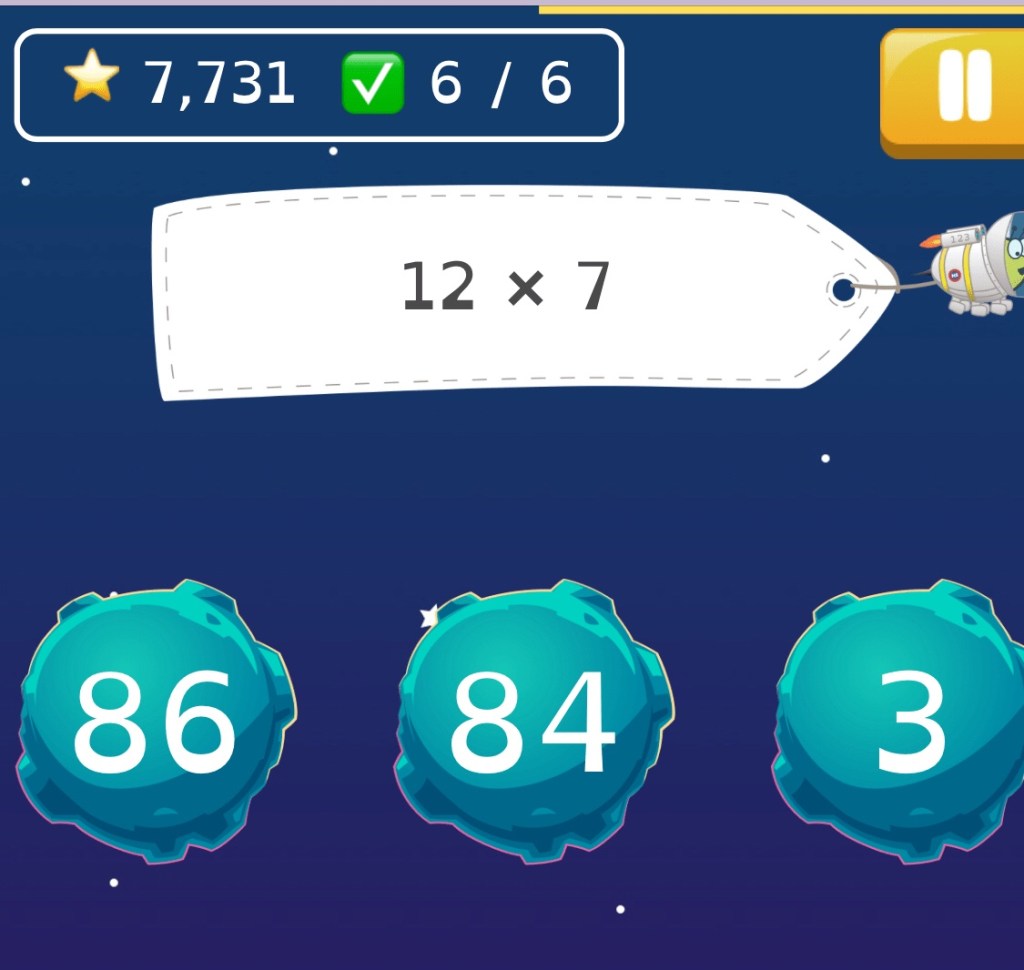
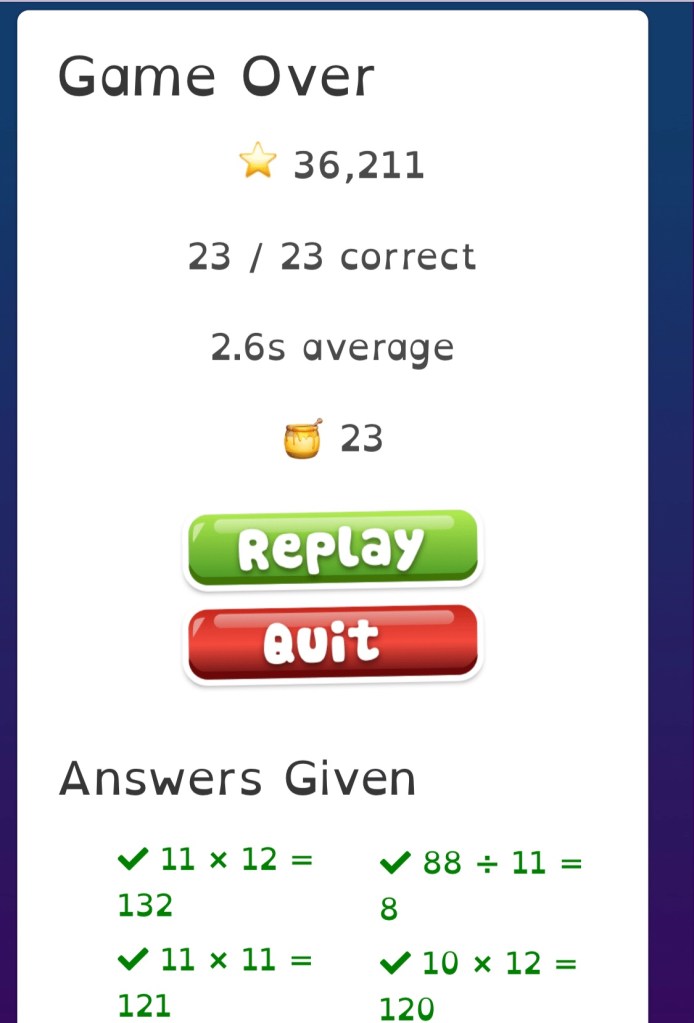
Math Shed is a fun fast paced math fluency practice game. Students are able to practice several skills focusing on :

  • Number Bonds
  • Powers of 10
  • Times Tables
  • Division
  • Addition and Subtraction
  • Year 4 Multiplications
  • Negative Numbers

Math Shed has designed the program so students can work on the targeted skills in depth by giving the students the option to select concept area and the degree of difficulty (easy, medium, and hard). My son is working on his time tables and I really enjoyed how he could pick from mixed, single, related +decimals, and year 4 multiplication. Having this option has allows him to cover multitude of skills at pace that works for him. The times tables also includes division and the facts 0-12 which I love because kids cover two skills at once.


Spelling Shed gives parents a variety of spelling list they can choose from for their student. Parents can choose from these already generate list that are phonics, dolch, fry, and UIL 3rd – 8th. Parents also have the option to create their own list, I personally used this option for my son. I really like the option of creating my own list because I was able to input my sons current homeschool spelling curriculum and have him use the program 3-4 days a week to practice. The teacher hub also allows you to do pre/post test and you can track your students knowledge. The teacher also lets you track all your students activity and gives you the ability to assign activities. Just like in Math Shed students can choose their activities and level of difficulty and earn points. The games offer the students a variety of ways for them to practice their words.

At the time of this review the cost for Math Shed or Spelling Shed is $24.95 a year for up to 5 students, if you decide to purchase both you can save 15% off. Both programs can be used on the computer or tablet. We have IOS system in homes and so my son played on his Ipad and our Macs. Overall these are great programs if you are looking to add some fun to your homeschool and summer enrichment.

Be sure you check out the other Crews reviews of Math Shed or Spelling Shed by clicking the banner below.

Until the Next Time,

Mom

Social Media Links:

Facebook: https://www.facebook.com/EdShed-US-113476190342149/
Twitter: https://twitter.com/EdShedUS
Instagram: https://www.instagram.com/spellingshed/
YouTube: https://www.youtube.com/channel/UCJKXC4Rd29eQQWPbSdITLhw